

Live header values
Status: ✅ Implemented · @Experimental
Intent
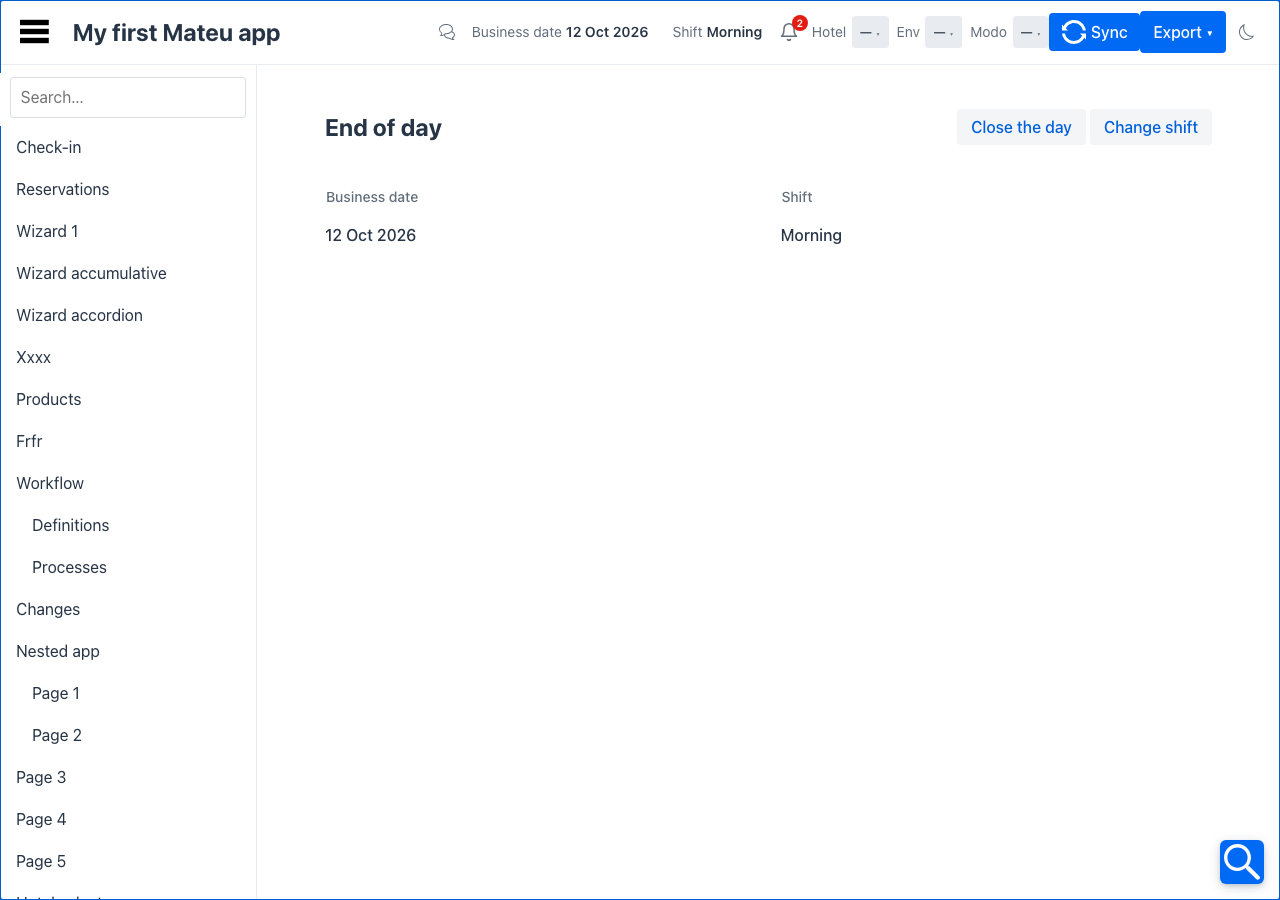
Section titled “Intent”Operational apps show a few facts on the header that everybody works against: the hotel’s business date, the current shift, a cut-off. They change rarely but for everyone at once — the night audit moves the business date, and a front desk still showing yesterday’s date is a real error. A header widget built when the shell loads goes stale until the next reload.
Solution
Section titled “Solution”The app class supplies the values; each has an id the server addresses it by:
@App(liveUpdates = true)public class Shell implements HeaderValuesSupplier {
    @Override    public List<HeaderValue> headerValues(HttpRequest httpRequest) {        return List.of(                new HeaderValue("businessDate", "Business date", hotel.businessDate()),                new HeaderValue("shift", "Shift", shifts.current()));    }}
Then change one in either of two ways:
| From | How | Who sees it |
|---|---|---|
| an action’s answer | return UICommand.updateHeaderValue("shift", "Night"); | this tab and the other tabs of the same browser |
| anywhere on the server | LiveHeaderValues.publish("businessDate", "13 Oct 2026"); | every open session of the app — with @App(liveUpdates = true) |
@Toolbarpublic Object closeTheDay() { var next = hotel.closeDay(); LiveHeaderValues.publish("businessDate", next); // every session, including this one return new Message("Day closed");}A change is announced to screen readers (“Business date changed to 13 Oct 2026”) and flashes briefly on the header (not with reduced motion).
How it travels — and why it is cheap
Section titled “How it travels — and why it is cheap”- Tabs of one browser share changes through
localStorage(thestorageevent): a tab that learns a new value tells the others. No request. - Other sessions: with
liveUpdates, each browser keeps one event stream open — not one per tab. The tabs elect a leader throughlocalStorage(a heartbeat every 5 s; a silent leader is replaced after 15 s), only the leader holds the stream, and it hands each change to the other tabs. That matters: browsers allow about six connections per host over HTTP/1.1, and a stream per tab would starve the app’s own requests. - The stream is the existing SSE endpoint every adapter already has (
/mateu/v3/sse/…) running the app-level_live-updatesaction — no new endpoint, no polling. It sends the last value published for each id first (a reconnecting browser catches up), then every publish, and an empty heartbeat every 20 s for proxies. The server ends it every 5 minutes on purpose and the browser reconnects at once; that bounds the life of a stream whose browser went away without the adapter noticing. - A shell built after a publish starts from the published value.
LiveHeaderValues is in-process: a publish reaches the sessions connected to that server. In a cluster, publish on every node (e.g. from the message listener that learns about the change).
It is all opt-in: without HeaderValuesSupplier there is nothing on the header, and without liveUpdates no stream is opened.
In YAML
Section titled “In YAML”type: AppShellliveUpdates: trueheaderValues: - id: businessDate label: Business date value: 12 Oct 2026A static bundle carries the values but never a stream (there is no server to stream from).
Where it works
Section titled “Where it works”- Vaadin — on the header next to the app-context pickers (
mateu-header-values). - Redwood (Oracle VB) — in the shell header, with the same tab sharing and one-stream-per-browser rule.
- React Native — at the top of the drawer; the stream while the app is in the foreground.
- IntelliJ plugin — at the top of the navigator; one background stream per session.
- Also from the C# (
IHeaderValuesSupplier,LiveHeaderValues.Publish) and Python (HeaderValuesSupplier,LiveHeaderValues.publish) backends — both serve the same/mateu/v3/sse/…stream.
Demo: demo-admin-panel → End of day (/e2-business-day, F8): Close the day publishes, Change shift answers a command. Open / in another tab and /e2-demo in another browser to watch both.
Related
Section titled “Related”- App context — a value the USER picks for every screen
- Long-running jobs — the same SSE endpoint