

Idle-session warning
Status: ✅ Implemented · @Experimental
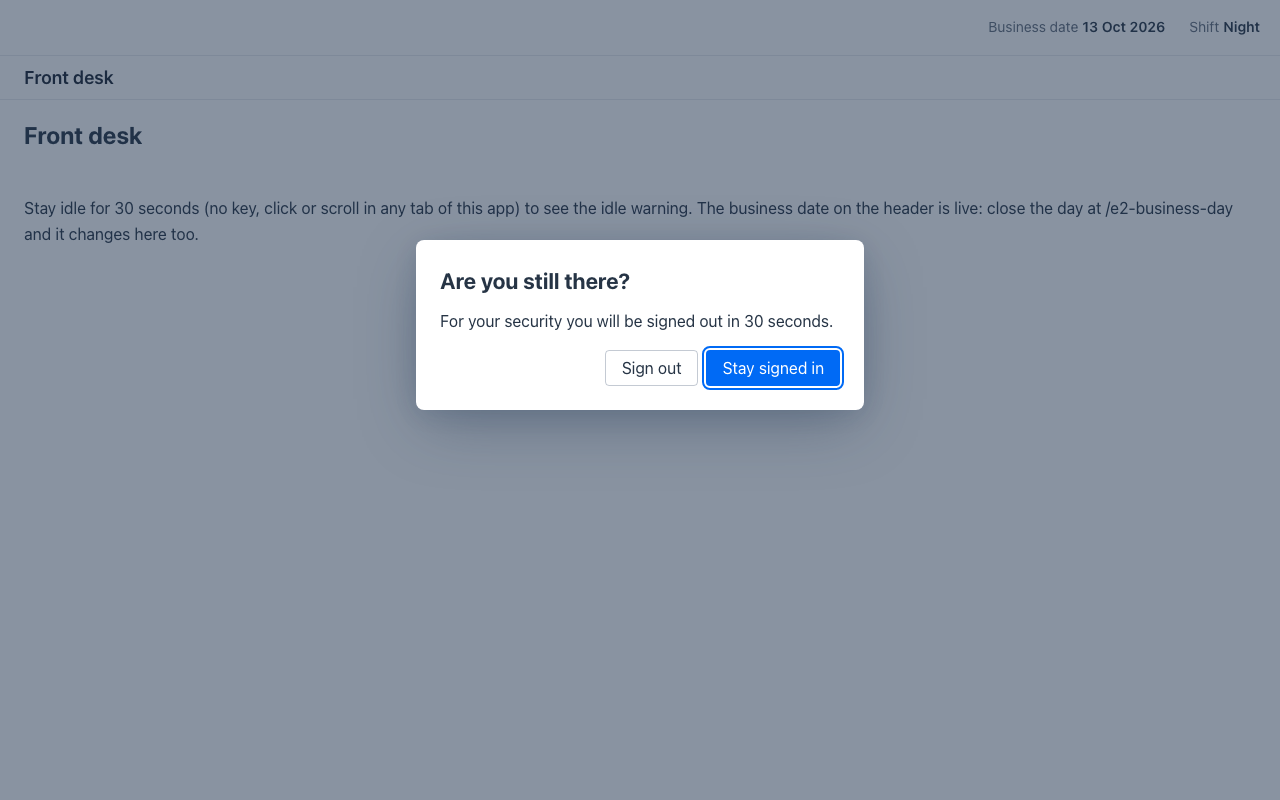
Intent
Section titled “Intent”Shared terminals — a front desk, a counter, a ward — must not stay signed in for whoever walks up next. Security policies ask for a sign-out after a period of inactivity, and users ask not to lose their work to it without warning.
Solution
Section titled “Solution”@App(idleTimeoutMinutes = 15, idleWarningSeconds = 60, idleSignOutUrl = "/logout")public class Shell implements KeepAliveHandler {
@Override public void keepAlive(HttpRequest httpRequest) { // optional: refresh whatever "signed in" means for this app (a token, a session) }}After idleTimeoutMinutes minus idleWarningSeconds without activity, a modal says “Are you still there?” and counts down:
- Stay signed in (also Esc, and the button that has the focus) runs the app-level
_keep-aliveaction — reaching the server is what renews an ordinary server session; aKeepAliveHandleron the app class is called too. - Sign out, or the countdown reaching zero, goes to
idleSignOutUrlwith a full page load — typically the app’s logout endpoint. Blank: the app’s own route.
Mateu does no authentication: what “signed in” and “sign out” mean is the app’s. Before navigating, a cancelable mateu-idle-sign-out event is dispatched on document (detail { url }) — an app with its own sign-out (an OIDC library, say) calls preventDefault() and does it itself.
Every tab counts
Section titled “Every tab counts”Activity is shared by the tabs of the app: each tab records its last key press, click, wheel or touch (not scroll: a shell scrolls by itself) in localStorage (at most every 5 s), and each tab measures idleness from the latest activity of any tab. Working in one tab keeps the others from warning; Stay signed in in one tab dismisses the warning in all; Sign out in one signs out the others. While the warning is up only Stay signed in keeps the session — a stray mouse move must not cancel a warning nobody saw.
In YAML
Section titled “In YAML”type: AppShellidleTimeoutMinutes: 15idleWarningSeconds: 60idleSignOutUrl: /logoutHow it relates to session expiry
Section titled “How it relates to session expiry”The two cover different ends:
| Idle warning | Session expiry | |
|---|---|---|
| Who decides | the client, from the user’s inactivity | the server, which answers 401 |
| When | before anything expires | after the token or session expired |
| What happens | a countdown; stay or sign out | the request is held; the app re-authenticates and it is retried |
They compose: if the server session has already expired when the user presses Stay signed in, the keep-alive request gets a 401 and goes through the session-expiry handling like any other request. Set the idle timeout shorter than the server’s session so the warning comes first.
Accessibility
Section titled “Accessibility”The warning is a modal alertdialog, labelled and described; the focus moves to Stay signed in (so Enter never signs out) and is trapped; Esc stays. The remaining time is announced again at 10 seconds.
Where it works
Section titled “Where it works”- Vaadin — the shared
mateu-idle-warningelement. - Redwood (Oracle VB) — an
oj-dialogwith the same cross-tab rules. - React Native — every touch counts; time in the background counts as idle; a modal with the countdown.
- IntelliJ plugin — IDE activity counts; a modal countdown dialog.
- Also from the C# (
[App(IdleTimeoutMinutes = 15)],IKeepAliveHandler) and Python (@app(idle_timeout_minutes=15),KeepAliveHandler) backends.
Demo: demo-admin-panel → /e2-demo (one minute, a 30-second countdown).
Related
Section titled “Related”- Session expiry
- Autosave — shrink the work an expiry can cost