Backend-driven frontend means that the frontend is a simple renderer which paints whatever the backend tells it to paint.
You do not write frontend code (javascript, html, css) but just backend code (java, kotlin, c#, …) which runs on a server. With that code, at runtime, you tell the renderer which is running in the browser what to paint, either explicitly when using the fluent interfaces or declaratively when using annotations.
This means that you are empowering the backend team to contribute the UI without any frontend team needed, enabling them to own the features end-to-end. That means a huge saving, indeed.
How it works
In Mateu the frontend is backed by an ephemeral java object in the server side, like illustrated in the following diagram:

The component at the bottom right of the diagram above is what you write when using Mateu. It’s the ViewModel in the Model-View-ViewModel (MVVM) pattern.
So, the following java code:
@MateuUI("")
public class Counter {

    @Output
    int count = 0;

    @Button
    Runnable increment = () -> count++;

}
Becomes this in the browser:
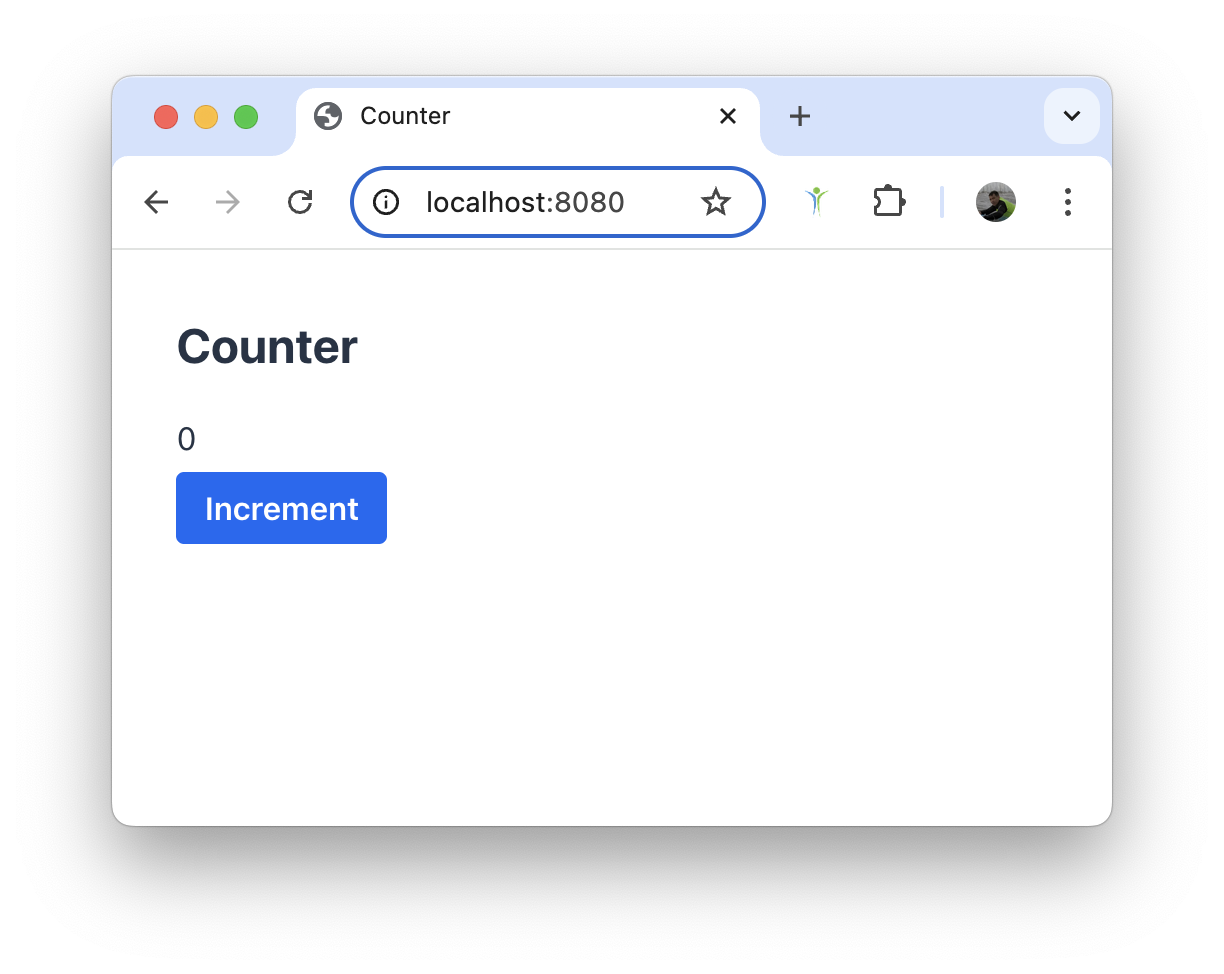
Or, you can say the same in a fluent imperative way:
@MateuUI("")
public class Counter implements ComponentTreeSupplier {

  int count = 0;

  @Override
  public Component getComponent(HttpRequest httpRequest) {
    return new VerticalLayout(
      new Text("" + count),
      new Button("Increment", (Runnable) () -> count++)
    );
  }

}
Please notice that, unless you defined your java class as a singleton bean, the java object is instantiated and hydrated on every api request. It does not survive between api calls. Mateu server side is stateless.
Binding backend and frontend
In Mateu any class can be a server side component. You link that class to the frontend by:
- Annotating the class with @MateuUI.
- Annotating the class with @Route.
- Fron a class which is already linked to the frontend, return an object as response to some event in the browser.
Interact with the frontend
That java class can interact with the frontend by:
- Handling requests from the frontend.
- Supplying frontend content.
- Supplying data to the frontend.
Singletons
You can declare your java class as a singleton according to the java framework you use, e.g. by annotating it with @Singleton or @Service.
If you do that your java class will be shared among all your requests, but please notice that it could lead to undesired effects, e.g. all users seeing the same values in the input fields.
If you do not want a singleton but create a new instance for each request just use @Named only or, if you are using Spring, just add the appropriate scope annotation, e.g. @Scope(“prototype”) (or @Scope(value = ConfigurableBeanFactory.SCOPE_PROTOTYPE)).